SSRS Dropdown parameter cannot be blank!
- Category: SQL Server Reporting Services
- Hits: 62028
I have created an SSRS report which can compare 4 reports side by side and brings up their latest execution times to the nearest millisecond. The report has 4 parameters. Each parameter is a dropdown populated by a list of all available reports.
Why?
I want the report to be run with the 3rd and 4th parameter as OPTIONAL. When I leave the 3rd and 4th parameter untouched (="<Select a value>"), the report complains saying "Report #3 parameter cannot be blank!". Before you ask, I have ticked both "Allow Blank" and "Allow NULL".
How?
This is the tough part. I was reading up on the MSDN page for the closest solution but it still didn't work for me. But the idea of inserting a NULL entry to select sounded good.
Aim / Objective
The plan will be to replace the default "<Select a Value>" with a custom null entry and the end-user will be none the wiser.
Performance Report - Background colors based on dataset values
- Category: SQL Server Reporting Services
- Hits: 46979
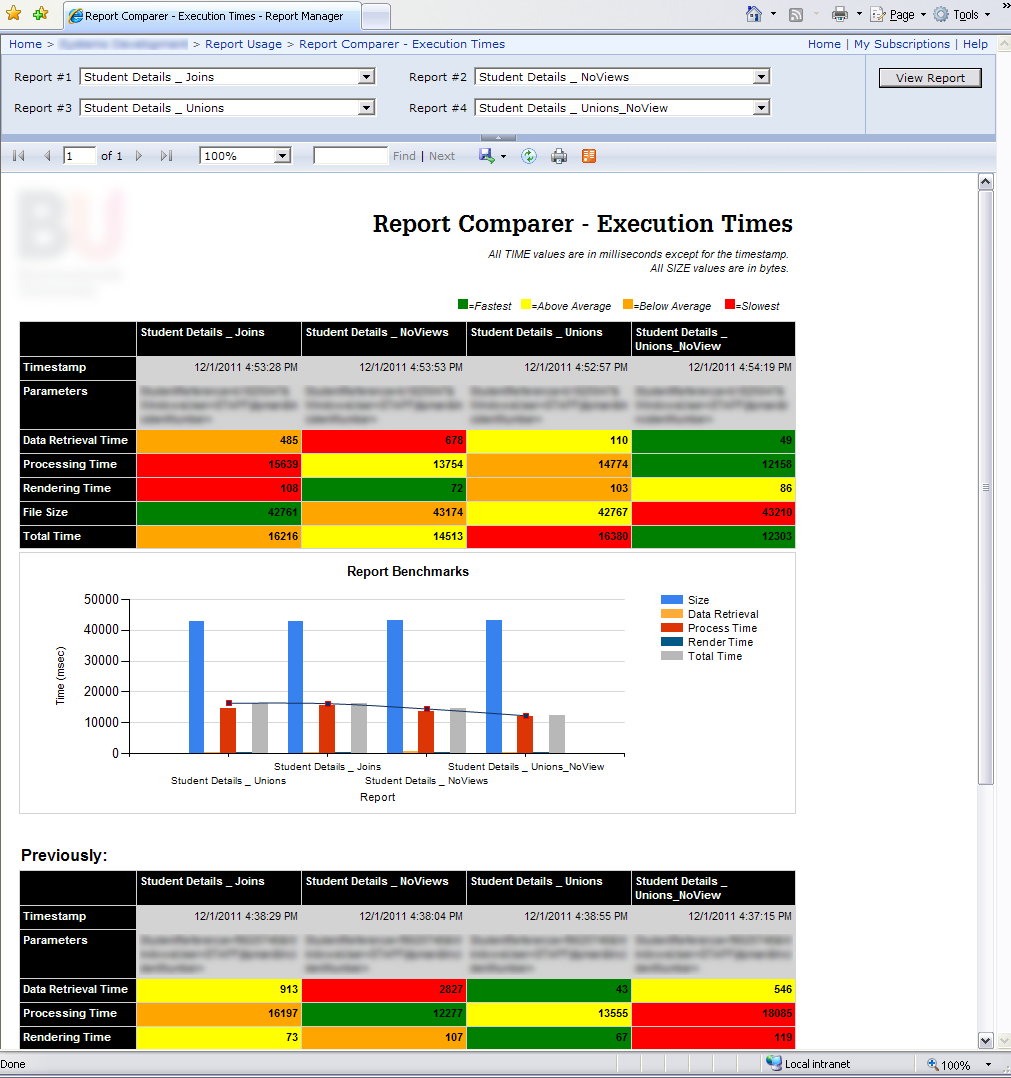
I've recently written a report for SQL Server Reporting Services 2008 R2 (SSRS) which will compare up to 4 reports and will compare the time taken for each one. The breakdown or what I was able to measure with the default installation are the times taken for "data retrieval", "processing", "rendering", and then the totals of these.
I haven't Googled this at the time of print so there may be a million better solutions out there, this is just how I did it. This may look like a horrible report which would fail an accessibility test but visually it says straight away which is the better report; and when comparing to the previous runs (using a second dataset) you can tell where changes were made and how this affected the reports' performance.
What?
What I'm trying to do is display a set of results (comparing various reports) in a table and then to color the backgrounds based on whether they are the fastest or slowest in the set.
Something like:
How to Display Report Execution Time in SSRS (milliseconds)
- Category: SQL Server Reporting Services
- Hits: 81333
So there are other articles out there but I was looking to display in milliseconds the execution time it took for a particular report (which searches for results matching the submitted parameter) to run.
Lifted from Dattatray Sindol's blog
Other sites have this solution as well so who copied off who is not my concern as this is not the solution to our problem. This is the solution that I initially used but my end-users were asking why is it always 0 seconds. This was because we were using the following MDX statement which had seconds as its smallest denominator:
="Execution Time: " +
CStr(System.DateTime.Now.Subtract(Globals!ExecutionTime).Hours) + " hour(s)" + " , " +
CStr(System.DateTime.Now.Subtract(Globals!ExecutionTime).Minutes) + " minute(s)" + ", " +
CStr(System.DateTime.Now.Subtract(Globals!ExecutionTime).Seconds) + " second(s)"

// yields
// 0 hour(s), 1 minute(s), 2 second(s)
This isn't what I want... It wasn't accurate enough and always saying 0 seconds was just confusing the end-user...

SSRS Zero Padding
- Category: SQL Server Reporting Services
- Hits: 224788
I didn't want to do this at the database level, mainly because it meant modifying the SQL query. The zero padding would need to be applicable within an MDX query.
The Situation
We have a database using Oracle 10g, and a SQL Server Reporting Services v2008 R2 environment. My use for this was when displaying an audit log displaying the oracle errors.
Oracle Errors
An Oracle error usually returns in the format of -12345. If we want to look them up the error is ORA-12345. Unfortunately Oracle also returns errors of less than 10000 so ORA-00201 would actually be returned as "-201". As I wanted a link so that the user can just click on this link and it would take them to http://ora-00201.ora-code.com/.
SSRS AlphaNumeric Parameter Validation
- Category: SQL Server Reporting Services
- Hits: 33217
If you ever want to check the parameters submitted with a report for alpha numeric characters (so it doesn't contain symbols, punctuations, etc) then you should do this at the database level, and then get the report to complete the check:
The Plan
- User enters value in parameters and clicks on "View Report"
- Report passes parameter to dataset which gets formatted by the database
- Report retrieves (select) formatted parameter as a field value to use
- Report loads with changes based on returned value.
The Gist
- Add database level parameter check
- Add IIF in SSRS to confirm
SSRS Retrieving Oracle Stored Procedure Success or ErrorLevel
- Category: SQL Server Reporting Services
- Hits: 56209
We have a report in SQL Server Reporting Services 2008 R2 (SSRS) reading from an Oracle 10g database which works great and lists all the details on a specific student. An additional request is that there appears a link that will run a stored procedure which
- Updates a timestamp in an existing table
- Inserts a row into an audit table
How?
Reminder on SSRS row separator
- Category: SQL Server Reporting Services
- Hits: 29344
- XP SP3 Workstation
- Business Intelligence Development Studio 2008 (BIDS)
- SQL Server Reporting Services 2008 R2 (SSRS)
I have a report displaying room bookings. Each row lists the day, date, room name, start/finish times, booking details and the staff contact. I want an empty row to appear between each day in the list, so I have:
SSRS Repeat Headers in PDF Report
- Category: SQL Server Reporting Services
- Hits: 34675
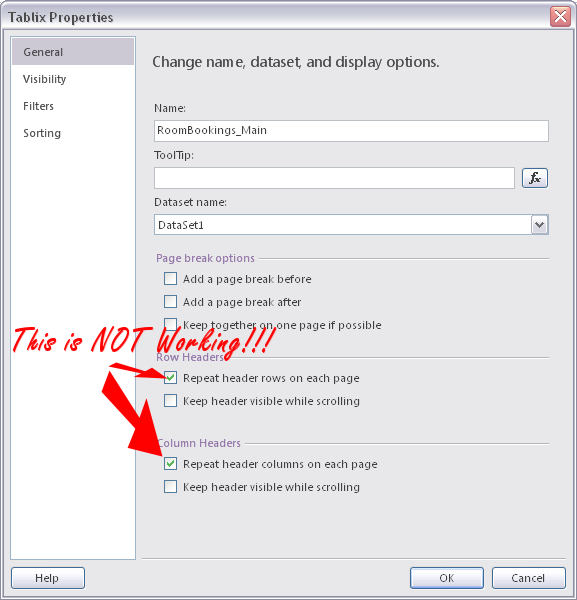
I've set some tablix headers but when I request the same report in PDF format, the tablix headers only appear once on the first page. Every subsequent page simply displays the report header (which does not include the tablix header... obviously). I right-clicked on the header row of the tablix and checked the box "Repeat header columns on each page.