
Using SQL Server Management Studio 2008:
- Connect to your database server.
- Expand Security > Logins.
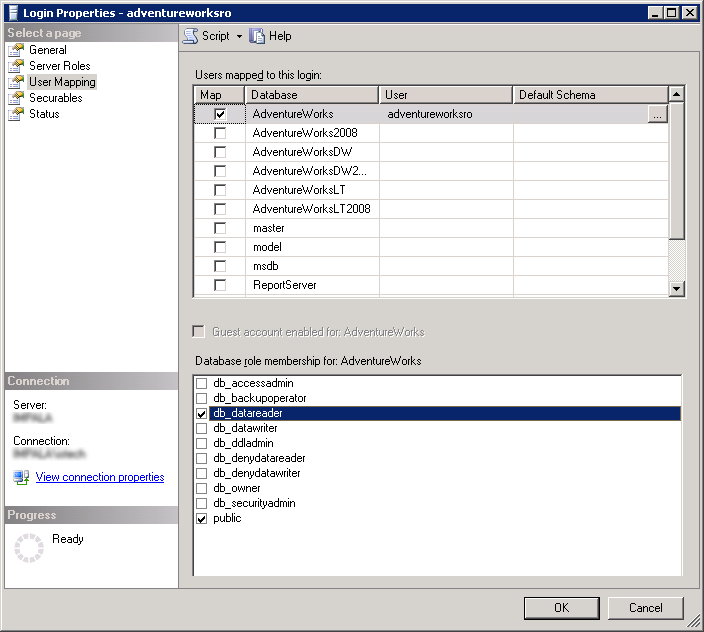
- Right-click on the user who will be set as having read-only access (in this example "adventureworksro").
- Select Properties.
- Select User Mapping.
- Map the login to the database they will have access to.
- Tick the boxes for role membership next to public and db_datareader.
- Confirm by clicking OK.
Database-level role names
from http://msdn.microsoft.com/en-us/library/ms189121(SQL.100).aspxdb_accessadmin
Members of the db_accessadmin fixed database role can add or remove access to the database for Windows logins, Windows groups, and SQL Server logins.
db_backupoperator
Members of the db_backupoperator fixed database role can back up the database.
db_datareader
Members of the db_datareader fixed database role can read all data from all user tables.
db_datawriter
Members of the db_datawriter fixed database role can add, delete, or change data in all user tables.
db_ddladmin
Members of the db_ddladmin fixed database role can run any Data Definition Language (DDL) command in a database.
db_denydatareader
Members of the db_denydatareader fixed database role cannot read any data in the user tables within a database.
db_denydatawriter
Members of the db_denydatawriter fixed database role cannot add, modify, or delete any data in the user tables within a database.
db_owner
Members of the db_owner fixed database role can perform all configuration and maintenance activities on the database, and can also drop the database.
db_securityadmin
Members of the db_securityadmin fixed database role can modify role membership and manage permissions. Adding principals to this role could enable unintended privilege escalation.
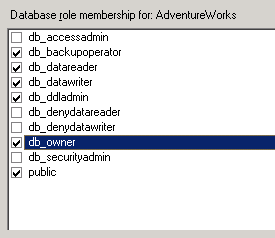
In theory, a user who can do nearly everything but modify access and security permissions:
Thank you very much for the information. As a JR.DBA I need all the help I can get!
Thnx voor the explanation great!
Hi Fely,
I'm so jealous as we're still on SQL Server 2008 R2. I'm also not 100% sure if the problem happens in v2012 for security reasons. I figure you add users to individual databases and not to the overall database server. The creating user will more than often have db_owner privileges. I can only suggest checking the other databases that this user is not allowed to access and set the db_denydatareader for them...
I created a new login and a new user and I mapped a database in SQL Server 2012. In the login properties in Securables, we selected permissions "deny" for "View any database" for the user to see only the specified database.
The problem is that the user does not see any database.
If I select "Grant" to "View any database", user can see all databases. How can I make the user can see only the specified database?
Thank you very much for posting and sharing this great article. It is so interesting. I want to know some other information about this site. So please give me this news quickly. I always will be aware of you.
:D wow it works grat
Excellent post.. Keep it up.
That’s such a great post!
Excellent i got more points..